Saturday, October 12, 2024

Common Mistakes in Site Safety Inspection Records and How to Avoid Them

 Site safety inspection records are critical to ensuring that construction projects and other related industries like oil and gas, mining, and manufacturing are not only safe but also compliant. What has happened sometimes despite the best of intentions is that errors in those records can bring about disastrous consequences like accidents, delays in project commencement, and liabilities in the court. Therefore, understanding what these errors are will help one keep the working environment not only safe but efficient as well.

Here are some of the most common mistakes made in Site Safety Inspection Records and how to avoid them best.

1. Incomplete or Inaccurate Documentation

One of the most common problems with Site Safety Inspection Records is that often they are not fully or accurately completed. The site inspectors omit some necessary safety information or fail to make a record of all the safety checks carried out. It is commonly the result of time pressures or the laborious nature of much traditional safety inspection work.

How to Avoid: Use automated safety inspection tools that can grab and track safety data in real-time to avoid incomplete or inaccurate documentation. Tools like viHUB provide a centralized, AI-powered system where users can easily capture and track site inspections. Such tools ensure that all conducted safety inspections are properly logged and stored accurately. This eliminates the possibility of human error as the records completed become comprehensive and reliable.

2. Failure to Track Changes and Updates

Construction sites are dynamic and are constantly changing as circumstances change, whether through new machinery introduction, actual modifications to the project scope or details, or updated safety procedures. If not reflected in Site Safety Inspection Records, these changes may serve to provide inaccurate assessments of the current conditions of a site and thus potentially compromise safety.

How to Avoid: This can be prevented through the use of a proper track of inspection records, which also comes with regular updates. Solutions for such applications as viHUB will allow you to compare your current site progress with some previous records and ensure that changes and updates are not missed in addressing them. The platform also allows seamless integration of the IoT, BIM, and CCTV systems, which easily increases the task of site comprehension and monitoring. This would imply that modifications reflect themselves instantly through your inspection reports and even create up-to-date records.

3. Neglecting the Importance of Real-Time Monitoring

Most companies use periodical checks, which fail to acknowledge the need for real-time monitoring. Without real-time monitoring, managers may even not spot instant safety risks that threaten the crew.

How to Avoid: Your new best friend in the game of safety compliance can be real-time monitoring. With viHUB's smart platform, real-time project reports using 2D or 3D reports can help you to immediately detect risks brought about by violations of proper use of PPE or intrusion into danger zones. You can solve issues still in the early stages and not mushroom into major risks by incorporating real-time monitoring into your safety inspection activity.

4. Overlooking Minor Violations

In addition, another mistake is the downplaying of minor infractions. For instance, workers are not wearing gloves for protection or standing too close to hazardous areas. These little transgressions may be perceived as insignificant but can eventually lead to very serious accidents or add up to more significant infractions in the long term.

How to Avoid: AI-based tools such as viHUB can assist in the detection of minor safety violations with the help of AI modules made especially for PPE detection and danger alerts. The system continuously scans the worksite and sends immediate alerts if it detects violations of any kind, thus never letting those minor violations slip through to be unreported to the management.

5. Disorganized Record-Keeping

Another common error is that of poor organization or scattershot safety records. This makes it impossible to produce the necessary documentation at audit time or during an incident if your inspection records are dispersed or not stored in a usable form. This then can delay the resolution of safety issues and create compliance breaches.

Conclusion

Keeping site safety inspection records delivers a crucial component of any successful project, particularly in the construction, oil & gas, and mining industries. This is, therefore, essential for firms seeking to further enhance their levels of safety compliance by avoiding the pitfalls of incomplete documentation, no real-time monitoring, and inconsistent reporting. Leveraging tools like viHUB has provided an automated solution driven by AI that may make it possible to increase the accessibilities and efficiency in managing safety on a real-time, tracking, and documentation level as required by the management. Adopting these technologies will enable organizations to reduce safety risks, conserve inspection costs, and also increase overall site productivity.

Visit Our Social Media Details :-

Facebook :- viactai


Linkedin :- viactai


Twitter :-aiviact


Youtube :-@viactai


Instagram :-viactai/

Blog Url :-

Protecting Drilling Rigs: Intrusion Detection System for Oil & Gas Industry
Elevating Safety: AI-based Crane Collision Detection Systems for Monitoring

The Future of EHS in Construction: Trends to Watch in 2024

 The construction industry has always changed very fast as it considers an evolution of new technologies and redesigning of regulatory requirements reshaping environmental health and safety practices. Moving into 2024, EHS Solutions for Construction will be pushed to become even more technically sophisticated by some fast-paced innovations in AI, data analytics, and cloud-based platforms. Here's a look at some key trends to watch for in 2024 that will change the future of EHS in the construction industry.

1. AI-Powered Video Analytics for Real-Time Safety Monitoring

AI is going to change safety standards in construction. By 2024, it will represent a massive video analytics push-the AI-powered. Construction companies are increasingly involving AI in monitoring sites in real time. Pointing out key safety concerns such as slips, falls, trips, dangerous zone intrusions, etc are now possible through AI. For example, such solutions as viAct Construction Safety Software track worker behavior using AI-based video analytics, detect the lack of personal protective equipment and send real-time risk alerts to the supervisor.

While minimizing workplace accidents, these EHS solutions for construction also help optimize productivity through the automation of monitoring for safety and the reduction of much manual oversight. Scalable and cost-effective AI-based systems make such solutions basic tools that must be used by project managers and EHS officers in the coming year 2024.

2. Edge Computing and Cloud Integration for EHS Solutions

The confluence of cloud integration and edge computing is ready to redefine how construction companies deal with and store EHS data. Solutions such as viAct offer cloud, on-premise, or hybrid deployment modes, giving room for flexibility in how companies want to use data and protect it under industry regulations, such as the GDPR. With real-time data collection integrated into construction sites and cloud processing, extensive safety insights can be derived much quicker.

With construction EHS solutions further becoming increasingly cross-platform-integrated, a firm can consolidate data from various sources such as cameras, AI modules, and mobile applications while protecting infrastructure security with advanced encryption to make the whole safety monitoring process more efficient and transparent.

3. Proactive Environmental Monitoring and Compliance

Of all, the construction industry remains in the limelight for cutting carbon footprints and abiding by environmental standards. In 2024, environment, health, and safety solutions for construction would go beyond merely safety and surveillance to be carried out within the environment itself. Real-time monitoring systems for construction sites would track leaks of toxic gases, waste water, handling waste, and illegal dumping in a viAct Environmental Monitoring Module.

As governments move to introduce tougher environmental regulations, automated monitoring systems are going to be the key to compliance monitoring.

4. Data-driven EHS Solutions for Better Decision-Making

Now with the help of AI and potential data analytics, companies can generate massive safety data aimed at spotting trends and predicting risks early For example, throughout Safety Software Dashboard, a called viHUB, gets a bird’s eye view of on-site security with real-time reporting, automated employee counting and tracking tools.

The use of data-driven insights is helping companies be more transparent through the job site while responding quickly to emergent risks. The change in safety management towards a more data-centric approach will yield huge reductions in accidents and provide an edge in competitiveness in the construction sector to deliver projects within the estimated time frame and budget.

5. Wearable Tech and IoT in Construction EHS

The wearables and IoT integration with EHS are some of the emerging trends for 2024. Wearables, in this manner, will be able to measure the vital signs of workers, monitor the movement of workers, and detect the presence of toxic materials to which the workers are exposed. A combination collaboration with EHS construction solutions can take responsibility for ensuring real-time data about the health and well-being of workers, preventing overexertion, and safety compliance in terms of applied safety protocols.

Conclusion

It is truly radiant that the solution for EHS in construction has an optimistic outlook and ties up with the most leading-edge technologies such as AI, cloud computing, and IoT. Construction companies embracing these innovations will be able to enhance worker safety while reducing accident rates; and generate increased productivity and compliance with environmental regulations. For instance, viAct's Construction Safety Software will enable safe sites, a streamlined workflow, and high transparency with minimal costs. Construction companies will be in the best position to handle the job-site challenges of tomorrow by being ahead of these trends.

Visit Our Social Media Details :-

Facebook :- viactai


Linkedin :- viactai


Twitter :-aiviact


Youtube :-@viactai


Instagram :-viactai/

Blog Url :-

How Generative AI Can Help in Ensuring Safety in the Oil & Gas Industry?
What are the Key Features of Safety Inspection Software Ideal for Saudi Arabia?

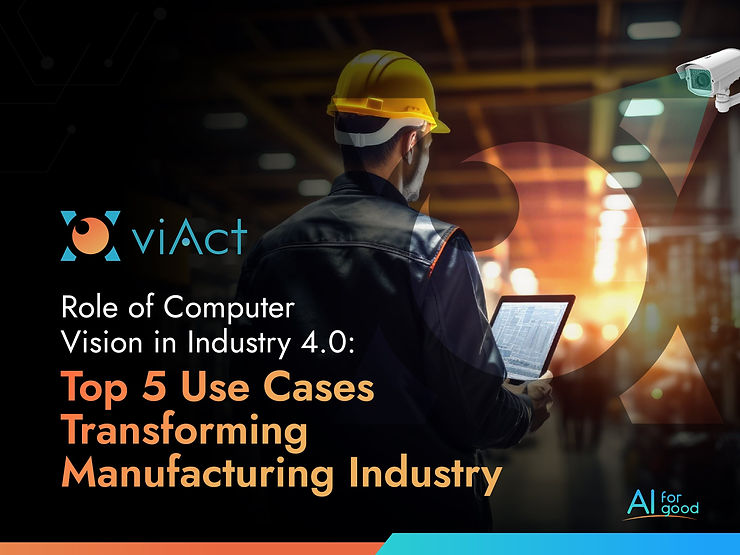
Top Applications of Computer Vision in Industry 4.0 for Enhanced Productivity

 With the advent of Industry 4.0, the rapid transformation in industries makes Computer Vision in Industry 4.0 a powerful instrument for increasing productivity and optimizing operations. Manufacturers and industrial sectors make use of real-time data, automation, and advanced monitoring systems through AI, machine learning, and the Internet of Things. This enhances efficiency, and safety, and reduces the costs of operations. Some of the most prominent applications of Computer Vision in Industry 4.0 and the future directions for changing the faces of modern industries.


PPE Detection for Worker Safety

Employee safety is one of the areas companies in the construction, manufacturing, and oil and gas industries are constantly improving on. Computer Vision in Industry 4.0 permits AI-based systems to check how well PPEs are being used. Cameras across sites deployed can detect if workers are properly fitted with required PPEs, such as helmets, gloves, or harnesses. In the event of a violation, the worker and officers involved are immediately messaged to address the transgression. Real-time monitoring in such cases reduces injury rates sharply at the workplace, but companies can comply with regulatory standards and protect their people.

Automated Product Inspection

Product quality control is another area where Computer Vision in Industry 4.0 can very significantly make a difference. AI-driven video analytics systems can inspect products on the production lines in real time so that defects or damaged products can be detected much more precisely than by human beings. This ensures that faulty products are identified and isolated at once so that the chances of faulty items reaching the customers are minimized with improvement in the quality of products overall.


Automated product inspection, in particular, is valuable in industries like electronics, automotive, and pharmaceuticals, where an imperceptible defect may mean a serious mishap. In fact, because these machines are designed to inspect large quantities, the result is increased output while still maintaining high standards of quality.

Forklift and Machinery Monitoring

The safe operation of machinery and automobiles like forklifts is one major phenomenon within industries. In Industry 4.0, Computer Vision is applied to monitor the real-time behavior of forklifts such as speed load and collision detection. The operators would be required to adhere to the safety protocols and accidents are finally reduced. Furthermore, AI systems can identify any abnormal conditions like overheating or overloading of machinery and provide instant alerts for preventive measures.

Inventory and Stock Management

Computer Vision in Industry 4.0 has changed the way of inventory and stock management by automating product counting and stock alerts. AI-enabled cameras track the products within a warehouse and assembly line, making sure that the records of the inventory are updated in real time. Thus, this automation system reduces the probability of human errors and ensures that the stock levels are always correct. Furthermore, the system enables automated alerts of running out of stock, hence allowing timely replenishment.

Fire and Smoke Detection

This particular area of industrial through fire and smoke detection using Computer Vision in Industry 4.0, it has been a game-changer. AI-powered cameras detect smoke and fire at the point of the initial incident, giving advanced warnings that prevent damage that may prove to be catastrophic. These warnings directly reach safety officers who take immediate action to contain the situation.


Advanced monitoring systems assist industries like oil and gas, manufacturing, and mining in lowering the more significant threat of fire. This reduces the risks to and losses for the workers and valuable assets and hence protects operations continuity and safety.

Conveyor Belt and Assembly Line Monitoring

The conveyor belt systems run as the lifeblood of most industrial processes. Failure in the line or any malfunction in it results in costlier delays and downtime. Computer Vision in Industry 4.0 involves constant monitoring of conveyor belts for blockages and breakdowns or issues. Once a problem is detected, AI triggers an alert to the maintenance team to address the problem before escalations occur.

Conclusion

As industries witness more and more acceptance of Computer Vision in Industry 4.0, the level of productivity goes up, safety becomes a comparative issue, and efficiency quite matches expectations. These applications now go from detecting PPE to forklift monitoring, from automated product inspection to inventory management. Through AI and video analytics, industries are streamlining their operations and creating safer and more efficient workplaces at the same time. It portends a very promising future, with greater competitiveness and productivity, as companies continue to adopt these advanced technologies.

Visit Our Social Media Details :-

Facebook :- viactai


Linkedin :- viactai


Twitter :-aiviact


Youtube :-@viactai


Instagram :-viactai/

Blog Url :-

The Future of Project Control Centers: AI Video Analytics Role in Smart Construction
AI Video Analytics for Smart Manufacturing: 5 Ways viAct Digitizing Future Factories in Saudi Arabia

Friday, October 11, 2024

AI in Site Safety Management: Improving Compliance and Reducing Human Error

 The construction industry has always suffered accidents, especially on dynamic and hazardous job sites. Observing such sites for safety compliance and mitigating risks usually took a huge amount of human resources. However, with the rapid uptake of AI in Site Safety Management, companies are changing how they ensure safety improve compliance, and reduce human errors. Industry transition towards a safer and more efficient work environment becomes possible with the inclusion of state-of-the-art AI technologies, such as those delivered by innovative mobile AI monitoring solutions by viMOV. The following report narrates how AI-driven systems change site safety management and what the benefits include.

Enhancing Compliance Through Real-Time Monitoring

One of the biggest challenges in construction safety is how the workers can always adhere to the regulations laid out. The old days made it a tiresome affair with basic monitoring techniques including checklists and supervisors whom man cannot be present everywhere at a go. AI in Site Safety Management offers a tremendous improvement through the use of real-time monitoring systems that are constantly keeping watch on several places. For instance, viMOV's AI technology dynamically recognizes dangerous zones, missing safety barriers, and workplaces where workers might risk their lives. Not only is it regulation-compliant but also prevents over-reliance on human supervisors. Then, practically no spot is left unreached.

Also, AI can classify workers based on Personal Protective equipment by identifying color codes and allow only those having the required equipment to enter hazardous areas. This is an important feature in that it prevents workers from accidentally wandering into dangerous areas without proper safety precautions. Instant alerts are issued whenever some form of compliance breach has been determined, allowing the construction managers to act immediately upon a hazardous situation. Over the long haul, this kind of monitoring leads to higher overall compliance and observance of safety protocols.

Reducing Human Error with AI-Driven Automation

Human error is one of the main causes of accidents on construction sites. Workers may be relaxed, tired, or distracted and would, therefore, miss some safety protocols. AI capabilities automate the monitoring of all aspects of safety with minimal risks from human error. Such systems as viMOV have superior AI processors that automatically identify danger zones by changes in the environment, such as holes or openings in the fencing. Unlike a human observer, the AI will not get tired or get distracted, or fall asleep, which keeps this much more reliable in preventing accidents.

For instance, AI-based systems can scan numerous places that would otherwise be covered by a whole group of people. Thanks to AI, companies can ensure the round-the-clock monitoring of even the most distant or inaccessible job sites. These systems send instant alerts via mobile devices to safety officers to help them react in time to possible hazards. Being able to act within seconds greatly decreases the chances of an accident and ensures a safer work environment.

Mobile AI Monitoring: A Game Changer in Dynamic Job Sites

The high mobility of easy deployment over various job sites are the noted features of solutions such as viMOV. Since the sites continue changing in industries, mobile AI monitoring ensures that measures of safety remain up-to-date everywhere. This plug-and-play system is designed to work with permanent power or internet for construction sites, oil rigs, and other dynamic environments.

With a battery capacity of around 50 hours, the equipment can spend as long as a week without needing to be constantly recharged. The portability ensures that safety systems become ready in just minutes, regardless of whether there is the existence of a power infrastructure at the site or not. The wireless alert system provides an added layer of security as it sends light and sound alarms to on-site workers in a second and simultaneously forwards SMS messages to safety officers and email messages to their email addresses.

Conclusion

In short, AI in Site Safety Management is only the appropriate development of how we consider safety within risky environments. With real-time monitoring, danger zone detection on its own, and high mobility, solutions like viAct transform the ways of achieving safety standards at construction sites or similarly industrialized sectors. This not only saves vital hours but also offers several other benefits like increased compliance, minimizing human errors, and significant cost savings. Therefore, such technologies must be adopted in the future to ensure workplace safety.

By embracing these AI-based technologies, organizations can ensure that workplaces are both safer and more efficient, while also maintaining compliance with relevant regulatory requirements and mitigating risks.

Visit Our Social Media Details :-

Facebook :- viactai
Linkedin :- viactai
Twitter :-aiviact
Youtube :-@viactai
Instagram :-viactai/

Blog Url :-

In the Line of Fire: AI's Protection in Oil & Gas Red Zones
Into the Red Zone: AI's Watchful Eye on Drilling Rigs

Why Under Lifted Loads Monitoring Critical in Construction and Industrial Workplaces?

 Construction and industrial projects are areas of busy activity, including frequent shifting of heavy loads by cranes and hoists, among other machinery. The dangers involved in the activities cannot be overstated, with particular emphasis on monitoring what happens underneath lifted loads. This is a procedure that entails careful looking at and controlling loads being shifted or suspended in general, usually overhead, to avoid accidents or harm to workers.

You will understand in the article how under-lifted loads monitoring is urgently needed, which is also critically implemented with advanced monitoring solutions like the mobile AI-based monitoring solution viMOV-and how it can transform safety standards in construction and industrial environments.

Real-Time Monitoring and Its Role in Preventing Accidents

One of the greatest contributions to the advancement of site safety is the use of real-time monitoring systems. Traditionally, loads have been monitored by human observers who monitor various aspects for potential risks and alerts on unsafe behavior. However, humans commit errors and get distracted at times, and missed signals are inevitable under these circumstances. Therefore, in many high-risk situations, manual monitoring turns out to be inadequate.

Since the advent of AI-based safety solutions, like viMOV, under lifted loads monitoring in real time has significantly become better.

Compliance with Safety Regulations

In most areas, there are safety regulations in place that require companies to adopt measures that monitor the loads lifted to keep workers operating near the hazards in absolute safety. Failure to do so may lead to legal action and whopping fines, even delaying an operation.

The regulatory bodies specifically outline the requirements for integrating AI solutions like viMOV. With these systems, any form of penalty that would be due to non-compliance is avoided as it ensures that the organizations take care to keep their client content safe and compliant at all times. For instance, with video analytics, the history of alerts is monitored by viMOV's AI monitoring system, which renders it rather easy for the organization to prove that they are observing proper safety measures.

Reducing Human Error

Among the major causes of accidents regarding underlifted loads, human errors are strongly pointed out. Workers may misjudge the danger of standing underneath suspended loads or fail to use the recommended procedures. Furthermore, the supervisors overseeing such activities may have become slack, distracted, or overwhelmed by other commitments at the job site.

AI-based solutions eliminate the potential for human mistakes. Systems such as viMOV do not get tired and lose concentration. It can operate 24/7 to monitor, thus ensuring it is always on its toes concerning observance of safety measures. The real-time monitoring and automated detection attributes of AI guarantee that minute shifts from safety measures, such as when an employee enters a danger zone or when some barriers are required are detected promptly.

The Role of High Mobility in Dynamic Work Environments

Construction and industrial sites are generally dynamic sites that are constantly changing states. Fixed site monitoring will not be very effective in such systems. With viMOV, users gain significant advantages in portability and ease of installation in various work sites. Being a battery-powered system, it can operate in remote or temporary locations for up to 50 hours.

viMOV is also designed to be plug-and-play. This makes it easy to quickly implement the technology on-site without requiring individual sensors for each worker. As a result, ensuring safety does not interfere with business activities. For its part, the system will automatically detect danger zones and raise the alarm, thereby allowing workers to quickly respond to risks in areas of operation.

Conclusion: Why AI-Powered Monitoring is the Future

More complex construction and industrial projects mean an increased demand for monitoring loads lifted effectively. AI-based solutions such as viMOV find themselves at the forefront of this evolution, providing real-time monitoring, and instant alerts, and ensuring compliance with safety regulations at construction and industrial sites.

Integration of AI in safety standards improves the prospects of minimizing accidents, protecting the workforce, and increasing operational efficiency. The advanced capabilities of AI, such as dynamic detection and high mobility, are changing job sites into an environments with minimal human error and accidents involving lifted loads.

Consequently, monitoring under lifted loads should be one of the most crucial components of any strategy for safety, especially in industries that rely on heavy machinery and constant movement of loads. Investments in innovative solutions such as viAct will both save lives and improve the productivity and reputation of the organization, making it a very smart, savvy, and future-looking investment.

Visit Our Social Media Details :-

Facebook :- viactai
Linkedin :- viactai
Twitter :-aiviact
Youtube :-@viactai
Instagram :-viactai/

Blog Url :-

Safety Management Systems (SMS): A Beginner's Guide
Generative AI Solutions to Reduce Total Recordable Incident Rate

Monday, September 30, 2024

Safety Compliance Software | viAct

 Ensure safety compliance with ease using viAct comprehensive software. Simplify your processes and protect your employees with our innovative solution. Request a Demo.

Safety Compliance Software

AI for Oil and Gas Industry | viAct

 Revolutionize the Oil and Gas Industry with viAct cutting-edge AI technology. Streamline processes and boost efficiency with our innovative solutions. Request a Demo.

AI for Oil and Gas Industry

AI Enabled Project Control Center (PCC) | viAct

 Transform your project management with viAct AI-enabled Project Control Center (PCC). Streamline tasks, increase efficiency, and stay ahead...